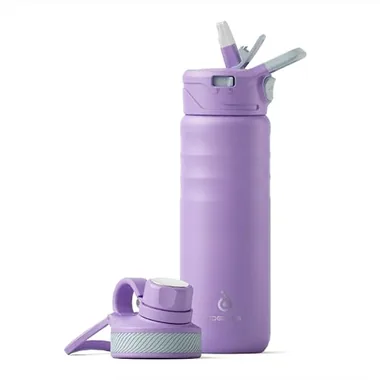
Care and cleaning
A vacuum wall does not care what you put in it. The lid does. Most of the range is dishwasher safe by the maker's own statement, gaskets come out of the lids that have them, and the smell people complain about is almost always a gasket rather than steel.
Vacuum drinkware is easy to look after and easy to ruin in one specific way: the steel is nearly indestructible, the lid is not. Everything below separates the two, because almost every care question in this category is really a lid question.
Start with what the maker actually states. Dishwasher safety is claimed for some pieces and not mentioned for others, and “not mentioned” is not the same as “no”, it is simply not a claim we can pass on. Where it is claimed, we say so on the piece's own page.


The outside is powder-coated on the coloured pieces. Powder coat is tough against knocks and unhappy about abrasives: a scouring pad will dull it and a dishwasher's top rack will not. The paint-chipping complaints in this category are mostly the result of the piece meeting a tiled floor, which no finish survives.
Never put a vacuum-walled piece in a microwave or a freezer. The wall is a sealed vacuum between two skins of steel, and both appliances are ways of stressing that seal. Ice cubes are fine. A freezer is not.
What the maker says about washing
| Piece | Dishwasher, as we state it | Lid type | Comes apart |
|---|---|---|---|
| 50 oz thermal carafe | Not stated | pour spout | Pouring head unscrews |
| 68 oz thermal carafe | Not stated | pour spout | Pouring head unscrews |
| 68 oz thermal carafe with a pour-over dripper | Not stated | pour spout | Pouring head unscrews |
| 68 oz thermal carafe with a 74 oz airpot dispenser | Not stated | pour spout | Pouring head unscrews |
| 68 oz thermal carafe with a 20 oz soup container | Not stated | pour spout | Pouring head unscrews |
| 68 oz thermal carafe with a 1.4 gallon dispenser | Not stated | pour spout | Pouring head unscrews |
| 24/34 oz insulated beer stein | Stated dishwasher safe | lid | No |
| 12 oz insulated bottle with a straw | Not stated | straw | Gasket lifts out |
| 12 oz insulated bottle with a straw and two lids | Stated dishwasher safe | straw | Gasket lifts out |
| 14 oz insulated bottle | Not stated | lid | No |
| 18 oz insulated bottle with a straw | Stated dishwasher safe | straw | Gasket lifts out |
| 24 oz insulated bottle | Not stated | lid | No |
| 24 oz insulated bottle with a straw | Stated dishwasher safe | straw | Gasket lifts out |
| 24 oz insulated bottle and two lids | Not stated | pour spout | Pouring head unscrews |
| 32 oz insulated bottle with a straw and two lids | Stated dishwasher safe | straw | Gasket lifts out |
| 32 oz insulated bottle and two lids | Not stated | pour spout | Pouring head unscrews |
| 32 oz insulated bottle with a straw | Stated dishwasher safe | straw | Gasket lifts out |
| 40 oz insulated bottle and two lids | Not stated | lid | No |
| 14 oz tumbler with a straw | Stated dishwasher safe | straw | Gasket lifts out |
| 14 oz tumbler with a handle and straw | Not stated | straw | Gasket lifts out |
| 18 oz tumbler with a straw | Stated dishwasher safe | straw | Gasket lifts out |
| 20 oz tumbler with a straw | Stated dishwasher safe | sliding | No |
| 32 oz tumbler with a handle and straw | Stated dishwasher safe | straw | Gasket lifts out |
| 17 oz travel tumbler | Stated dishwasher safe | lid | No |
| 20 oz travel tumbler, sliding lid | Stated dishwasher safe | sliding | No |
| 14 oz coffee mug with a handle | Not stated | lid | No |
| 16 oz coffee mug with a handle | Stated dishwasher safe | sliding | No |
Figures are the maker's own, as its descriptions stated them on 24 August 2026.
Getting the coffee smell out
Steel does not hold smell. Silicone does, and every lid in the range has silicone in it somewhere. That single fact solves most of the complaints: people scrub the inside of a cup that was never the problem and put the smell straight back in when they close the lid.
The method is on the right and takes an hour of soaking and two minutes of work. If the smell survives it, the ring has done its time, silicone is a consumable, and a ring that has held espresso every day for two years is not going to come back.
- Take the lid apart. Lift the silicone ring out of the lid and pull off the sliding hatch or the straw if the lid has one. The parts that hold smell are the parts you can remove.
- Soak the silicone. Put the ring and the small parts in a cup of warm water with a tablespoon of bicarbonate of soda for an hour. Silicone gives up absorbed oils slowly, so the hour matters more than the scrubbing.
- Scrub the lid recess. Use a small brush in the channel the ring came out of and under the hatch. This is where coffee oils sit and where a rinse never reaches.
- Rinse and dry open. Rinse everything, then leave the lid in pieces until it is dry. Reassembling a wet lid is how the smell comes back next week.
- Seat the ring flat. Press the ring back into its channel evenly all the way round. A twisted ring is the usual reason a lid that used to hold starts to seep.
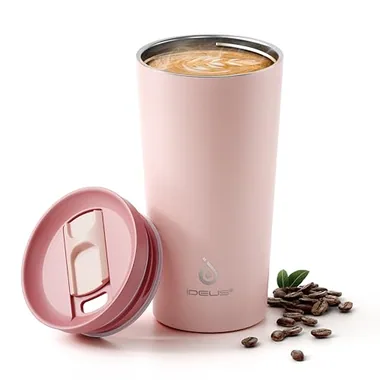
The two-minute leak check
Before deciding a lid has failed, do this. Fill the piece with cold water, close the lid the way you normally do, and stand it on a dry tea towel for ten minutes. Then lay it on its side on the towel for two, over a sink. A lid that seeps in the first test has a seating problem. A lid that only seeps in the second is behaving exactly as a splash-proof lid is supposed to.
That distinction matters. The second case is not a fault. Returning a piece for it is a disappointment nobody needed. 3 of the 27 pieces in the range carry a lid the maker itself describes as splash-proof, and the maker adds, in the same product page, that it is not leak-proof.
The lid tableGaskets and strawsThe long version of the smell guide