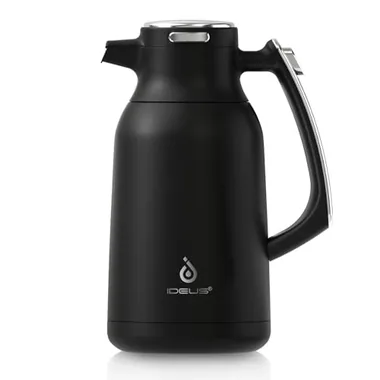
Hours hot, hours cold
These are the maker's own figures from its descriptions, not our measurements, and the honest thing is to say so plainly. Nobody publishes the room temperature, the fill level or the lid position behind numbers like these, so read them as a comparison between our own pieces rather than a promise about your commute.
| Piece | Hot | Cold |
|---|---|---|
| 50 oz thermal carafe | up to 12 h | up to 24 h |
| 68 oz thermal carafe | up to 12 h | up to 24 h |
| 68 oz thermal carafe with a pour-over dripper | up to 12 h | up to 24 h |
| 68 oz thermal carafe with a 74 oz airpot dispenser | up to 12 h | up to 24 h |
| 68 oz thermal carafe with a 20 oz soup container | up to 12 h | up to 24 h |
| 24/34 oz insulated beer stein | up to 1 h | up to 5 h |
| 14 oz insulated bottle | up to 12 h | not stated |
| 24 oz insulated bottle | not stated | up to 24 h |
| 32 oz insulated bottle with a straw and two lids | up to 12 h | up to 24 h |
| 32 oz insulated bottle and two lids | up to 12 h | up to 24 h |
| 40 oz insulated bottle and two lids | up to 12 h | up to 24 h |
| 14 oz tumbler with a straw | up to 6 h | up to 12 h |
| 14 oz tumbler with a handle and straw | up to 6 h | up to 12 h |
| 18 oz tumbler with a straw | up to 6 h | up to 12 h |
| 20 oz tumbler with a straw | up to 6 h | up to 12 h |
| 32 oz tumbler with a handle and straw | up to 12 h | up to 24 h |
| 17 oz travel tumbler | up to 6 h | up to 12 h |
| 20 oz travel tumbler, sliding lid | up to 6 h | up to 12 h |
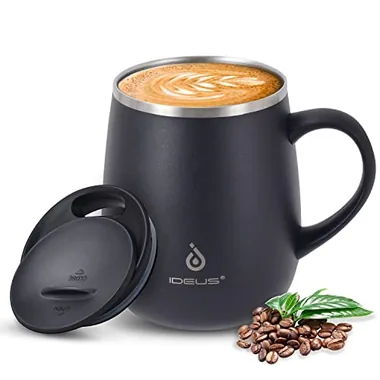
| 16 oz coffee mug with a handle | up to 6 h | up to 12 h |
Figures are the maker's own, as its descriptions stated them on 24 August 2026.
Hours are the number everybody compares and almost nobody defines. A vacuum wall does not keep a drink hot. It slows the rate at which the drink loses what it already has. That means the same mug gives wildly different answers depending on how full it is, how hot the coffee went in, whether the lid was on from the start, and whether it spent the morning in a cold car.


Mass matters more than most buyers expect. A 40 oz bottle filled to the shoulder holds its cold far longer than a 16 oz mug. Not because the steel is better but because there is five times as much cold water in it, and the surface it loses heat through has not grown five times. That is why the biggest stated numbers in this range belong to the biggest pieces, and why a half-full bottle behaves like a smaller one.
 +9
The lid is the other half. Every one of these figures assumes the lid is closed. A sliding cover left open turns the drinking hole into a chimney, and the first hour costs more than the next three. If you drink from a mug at your desk with the hatch permanently open, the number on this page is not the number you will get, and no vacuum flask on the market would give it to you.
These are the maker's figures, stated in its descriptions and updated on 24 August 2026. Treat the table as a comparison between pieces in one range rather than a promise about your particular Tuesday.