Choosing a size: 16, 20, 40 or 68 oz for how you actually drink
Volume on the box is not volume in the cup, a 40 oz bottle is a jug, and the size that suits you follows from one honest answer about your morning. A walk through the ladder with the numbers that matter.
By Marta Iken · published 24 August 2026 · updated 24 August 2026
Size is the decision people get wrong most often, and almost always in the same direction: bigger than they need, because bigger feels like better value and because the photograph does not convey mass. A full 40 oz bottle weighs about 1.4 kg. That is a heavy thing to carry to a desk you were going to sit at all day anyway.
This guide walks the ladder from a mug to a carafe and puts one question against each rung: who is this actually for?
- 12 oz insulated bottle with a straw12 oz
- 12 oz insulated bottle with a straw and two lids12 oz
- 14 oz tumbler with a straw14 oz
- 14 oz insulated bottle14 oz
- 14 oz tumbler with a handle and straw14 oz
- 14 oz coffee mug with a handle14 oz
- 16 oz coffee mug with a handle16 oz
- 17 oz travel tumbler17 oz
- 18 oz tumbler with a straw18 oz
- 18 oz insulated bottle with a straw18 oz
- 20 oz travel tumbler, sliding lid20 oz
- 20 oz tumbler with a straw20 oz
- 24/34 oz insulated beer stein24 oz
- 24 oz insulated bottle24 oz
- 24 oz insulated bottle with a straw24 oz
- 24 oz insulated bottle and two lids24 oz
- 32 oz insulated bottle with a straw and two lids32 oz
- 32 oz insulated bottle and two lids32 oz
- 32 oz tumbler with a handle and straw32 oz
- 32 oz insulated bottle with a straw32 oz
- 40 oz insulated bottle and two lids40 oz
- 50 oz thermal carafe50 oz
- 68 oz thermal carafe68 oz
- 68 oz thermal carafe with a pour-over dripper68 oz
- 68 oz thermal carafe with a 74 oz airpot dispenser68 oz
- 68 oz thermal carafe with a 20 oz soup container68 oz
- 68 oz thermal carafe with a 1.4 gallon dispenser68 oz
Volume on the box is not volume in the cup
The first correction is arithmetic. Stated capacity is the vessel filled to the brim, and nobody drinks from a vessel filled to the brim, least of all one with a press-in lid that displaces liquid when it goes in.
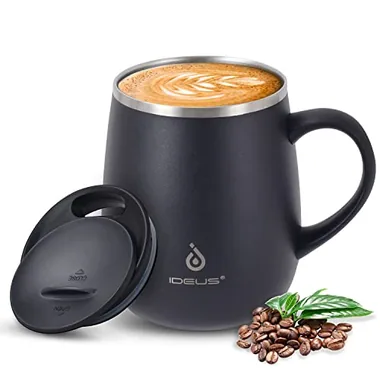
On the 16 oz mug the working figure is about twelve ounces of coffee. That is a full mug by any domestic standard, a standard American mug is eight to twelve, but it is not sixteen, and people who bought sixteen to replace a twelve-ounce cup are the ones writing surprised reviews. The same discount, proportionally smaller, applies right up the ladder.
 +9
+9

The ladder, rung by rung
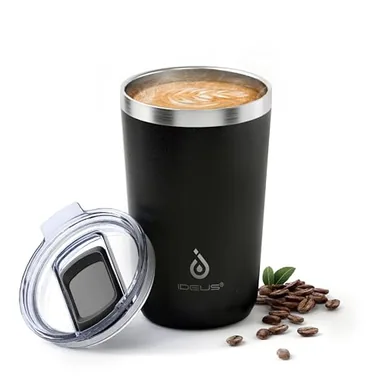
Around 14 to 16 ounces. One large coffee. This is the desk size and the size of a mug with a handle, which is what a desk wants: a handle means you pick it up without wrapping your hand around a hot vessel, and it means it sits where you put it. It is the wrong size for a day of water and the wrong shape for most cup holders.
17 to 20 ounces. The commute size. Tall enough to hold a proper coffee, narrow enough for a console, and the size class in this range where sliding lids live. The trade is the lid: this is the rung where the maker says splash-proof and means it.
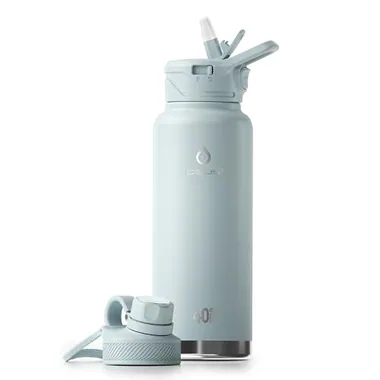
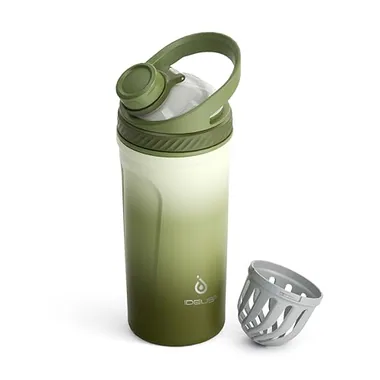
24 to 32 ounces. The day size, and the one most people should probably buy if they are buying one thing. Big enough that you fill it once in the morning and stop thinking about water, small enough to carry without resenting it. This is also where the straw pieces sit and where the leak-proof claims start.
40 ounces. Genuinely a jug, about a litre and a fifth. Excellent in a car, in a gym bag, on a desk you do not want to leave. Heavy enough that you will notice it on a walk, and wide enough that it defeats a lot of cup holders.
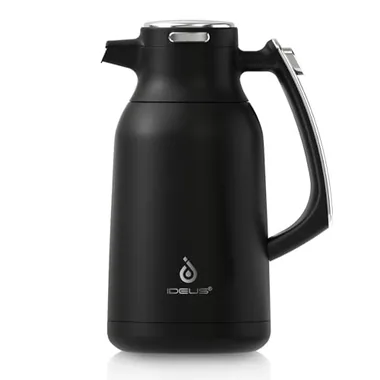
50 to 68 ounces. Not a personal vessel at all. A carafe is for a table with more than one person at it, or for one person who wants four mugs of coffee available without going back to the machine. Nobody carries these anywhere.
| If your day looks like this | Rung | Piece to start from |
|---|---|---|
| One coffee, at a desk, gone cold by ten | 14–16 oz | 16 oz coffee mug with a handle |
| A coffee that has to survive the drive in | 17–20 oz | 20 oz travel tumbler, sliding lid |
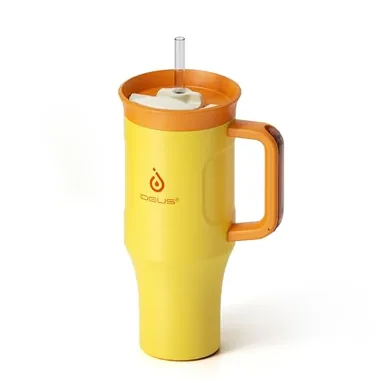
| Water all day, refilled once, sometimes in a bag | 24–32 oz | 32 oz tumbler with a handle and straw |
| Gym, site work, a car in summer | 40 oz | 40 oz insulated bottle and two lids |
| A table, a meeting, more than one cup | 68 oz | 68 oz thermal carafe |
The two questions that actually decide it
Ignore the ladder for a second and answer these instead. How long does one filling need to last? And does it travel lying down?
The first sets the volume and nothing else does. If the answer is “until eleven”, a 16 oz mug is right and a 40 oz bottle is 24 ounces of dead weight. If the answer is “all day, and I hate refilling”, buy the volume and accept the mass.
The second sets the lid, and the lid decides which sizes are even available to you. Pieces whose descriptions claim leak-proof cluster at 14 to 40 oz. The mug and the sliding-lid tumbler are upright-only whatever their volume. If your bag is part of the plan, the second question overrules the first.
| The question | What it decides | What it costs you if you answer it wrong |
|---|---|---|
| Where does it live? | the lid, before anything else | an upright-only lid in a bag, or a handle that fouls the cup holder |
| How much do you drink between refills? | the rung on the ladder | a piece you top up twice a morning, or a jug you carry half empty |
| Which of the two would you not give up? | which one wins when they conflict | a compromise that sits in a cupboard |
Weight, and why it changes minds
Water weighs a kilogram a litre and steel adds its own. A full 32 oz is around 1.1 kg. A full 40 oz is around 1.4 kg. A 68 oz carafe full of coffee is over two. Those are not abstract numbers when the vessel is hanging off a finger or riding in a tote against your hip for twenty minutes.
The practical rule people arrive at after owning two of these: buy the size for the journey, not for the day. If the day needs two litres and the journey is a walk to an office with a tap in it, buy the smaller vessel and refill. If the journey is the day, a site, a hike, a long drive, buy the volume.
How much do you actually drink?
Most people cannot answer this and most people are wrong when they guess. Two days of paying attention settles it better than any calculator: fill whatever you use now, mark the time, and note when you refill. If you refill twice before lunch, you are a volume buyer. If a cup goes cold before you finish it, you are a temperature buyer, and a smaller vessel is the fix rather than a bigger one.
The cold-coffee problem in particular gets solved backwards. Somebody buys a bigger insulated mug because the coffee got cold, then finds themselves drinking a large volume of lukewarm coffee instead of a small volume of hot coffee. The vessel was never the problem. The pour was.
Water is the opposite case. Almost nobody drinks less water because their bottle is big, and the refilling is the friction that stops people drinking. That asymmetry is the practical rule this whole guide reduces to: buy small for hot drinks, buy big for cold ones.
What the numbers mean when you compare them
| Size | Roughly what it holds | Full weight | Where it belongs |
|---|---|---|---|
| 14–16 oz | One large coffee, about 12 oz with the lid in | under 700 g | A desk, a kitchen, a passenger seat |
| 17–20 oz | A large coffee with room, or a bottle of water | about 800 g | A car cup holder |
| 24–32 oz | Half a day of water, or two coffees | 1.0–1.2 kg | A bag, a gym, a site |
| 40 oz | A jug: most of a day of water | about 1.4 kg | A car, a desk you do not leave, a long drive |
| 50–68 oz | Four to six mugs, or a table's worth | over 2 kg | A table, a meeting, a kitchen counter |
Weight is the column people skip and the column that changes minds. A kilogram hanging from two fingers on a fifteen-minute walk is a different object from the one that looked good in a photograph.
Two sizes people regret, and why
The first is the oversized bottle bought for an office. It works in a car and on a site. On a desk it is a nuisance: it will not go under most coffee machines, it will not stand in a drawer, and refilling it means a walk to a tap that takes a jug rather than a cup. Somebody with a tap ten steps away almost always ends up happier with 24 oz.
The second is the undersized mug bought for a commute. Twelve to fourteen ounces is a lovely desk size and it runs out halfway through a long drive, which is exactly when refilling is impossible. A commute wants the size up from the one that suits your kitchen.
Both regrets have the same root: buying for the place you imagine using it rather than the place you will actually use it.
- 16 oz coffee mug with a handle18 colourways
- 68 oz thermal carafe with a 74 oz airpot dispenser13 colourways
- 68 oz thermal carafe with a pour-over dripper8 colourways
- 68 oz thermal carafe with a 20 oz soup container8 colourways
- 24/34 oz insulated beer stein7 colourways
- 68 oz thermal carafe6 colourways
- 20 oz travel tumbler, sliding lid6 colourways
- 14 oz insulated bottle6 colourways
Sets, second pieces and the cost of duplication
Once a second piece is on the table the calculation changes, because two vessels can specialise. The most common happy pairing in this category is a handled mug at the desk and a 32 oz with a straw for everything else: one is shaped for sipping something hot at a keyboard. The other for drinking a lot of something cold without tipping it.
The unhappy pairing is two vessels of nearly the same size in different colours, which is what happens when the second purchase is made on impulse rather than on a gap. If you already own something in the 17 to 20 oz class, the useful second piece is either much smaller or much bigger.
Prices in this range are low enough that two pieces cost less than one premium-brand vessel, which is the practical argument for specialising rather than compromising.
A size for a gift, when you do not know the person's habits
Gift buyers have the hardest version of this problem: no data, no returns conversation, and a colour decision on top. Three things make it safe.
- Choose the middle of the ladder. A 20 to 24 oz piece is useful to almost everybody and looks generous without being unwieldy.
- Prefer a handle if the person works at a desk, and a straw lid if they carry things about. Both are visible decisions that say the gift was chosen rather than grabbed.
- Pick the colour last and pick it boldly. This is the one category where a strong colour is safer than a neutral: people who did not want a vessel at all still enjoy one that looks like a decision.
| The pairing | What it gives you | What it costs |
|---|---|---|
| A desk mug and a day bottle | a lid you open all morning and a lid you close and forget | two pieces to wash |
| Two pieces of nearly the same size | a second colour | nothing you did not already have |
| One piece asked to do both | one thing to wash | an upright-only lid in a bag, or a jug on a desk |
Two into one rarely works
The last trap is trying to buy one vessel for coffee and water both. It half works. Coffee wants a narrow mouth, a lid you drink from directly and a size around a mug. Water wants a wide mouth for ice, a straw or a big opening, and volume. A wide-mouthed 32 oz makes indifferent coffee and excellent iced water. A 16 oz mug is a lovely coffee vessel and a joke as a water bottle.
If the budget stretches to two pieces, the pair most people end up happy with is a mug for the desk and a 32 oz for everything else. If it stretches to one, answer the two questions above honestly and buy the one that wins, rather than the compromise that loses twice.