Will it fit your cup holder? How to measure before you buy
Cup holders are not standardised, no product page in this range publishes a base diameter, and the difference between a 66 mm holder and an 86 mm one decides the purchase. Here is how to measure yours in thirty seconds and what the shape of a tumbler does that the numbers never show.
By Marta Iken · published 24 August 2026 · updated 24 August 2026
This is the question that decides more tumbler purchases than colour, price and insulation put together, and it is the one nobody can answer for you from a product page. Cup holders vary by close to an inch between cars. Some have a spring insert that grips a small cup and refuses a big one. The rear console of the same vehicle is often not the same size as the front.
So this guide does two things. It gives you a method that takes half a minute and settles the question exactly, and it explains the three shape problems that make a tumbler fail even when the base measurement says it should fit.
- 12 oz insulated bottle with a straw12 oz
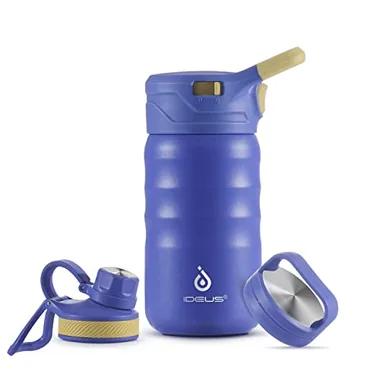
- 12 oz insulated bottle with a straw and two lids12 oz
- 14 oz tumbler with a straw14 oz
- 14 oz insulated bottle14 oz
- 14 oz tumbler with a handle and straw14 oz
- 14 oz coffee mug with a handle14 oz
- 16 oz coffee mug with a handle16 oz
- 17 oz travel tumbler17 oz
- 18 oz tumbler with a straw18 oz
- 18 oz insulated bottle with a straw18 oz
- 20 oz travel tumbler, sliding lid20 oz
- 20 oz tumbler with a straw20 oz
- 24/34 oz insulated beer stein24 oz
- 24 oz insulated bottle24 oz
- 24 oz insulated bottle with a straw24 oz
- 24 oz insulated bottle and two lids24 oz
- 32 oz insulated bottle with a straw and two lids32 oz
- 32 oz insulated bottle and two lids32 oz
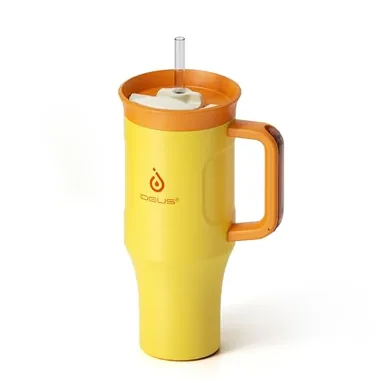
- 32 oz tumbler with a handle and straw32 oz
- 32 oz insulated bottle with a straw32 oz
- 40 oz insulated bottle and two lids40 oz
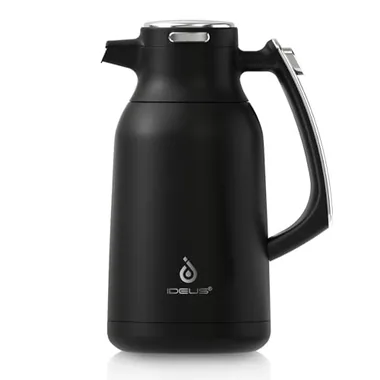
- 50 oz thermal carafe50 oz
- 68 oz thermal carafe68 oz
- 68 oz thermal carafe with a pour-over dripper68 oz
- 68 oz thermal carafe with a 74 oz airpot dispenser68 oz
- 68 oz thermal carafe with a 20 oz soup container68 oz
- 68 oz thermal carafe with a 1.4 gallon dispenser68 oz
Measure the holder, not the cup
You are looking for the diameter of the opening at its widest point, and then the depth. Both matter, and most people only check the first.
- Lay a ruler across the opening and read the widest inside-to-inside distance. Ignore any rubber fingers or spring inserts. Measure to the hard wall behind them, then note whether the fingers can be pushed flat.
- Drop the ruler in vertically to find the depth. Anything shallower than about 60 mm holds tall vessels badly no matter what the diameter says.
- Check the space above: a console lid, a gear selector or a handbrake will foul a tall tumbler long before the base is the problem.
Most holders land between 66 and 86 mm across, roughly 2.6 to 3.4 inches. Knowing which end of that range you are on is the whole game.


The three shapes that fail a fit that should have worked
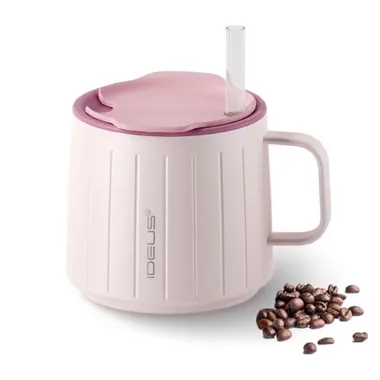
The first is the handle, and it is the one that catches people who measured carefully. A handled mug can have a base that drops in perfectly and still be unusable, because the handle meets the console, the gear lever or your elbow. Handled pieces are desk pieces and table pieces. That is not a defect. It is what a handle is for.
The second is taper. A tumbler that narrows towards the base sits deep and steady even in an oversized holder, because it wedges. A straight-sided vessel of the same diameter sits high and rocks. Two tumblers with the same base measurement can behave completely differently in the same car for this reason alone.
The third is centre of gravity, and it only shows up when the vessel is full. A tall 32 oz with a narrow base is stable empty and top-heavy full, which is when it matters, at the roundabout, with the lid you now hope is better than splash-proof.
Which pieces the maker itself calls cup-holder friendly
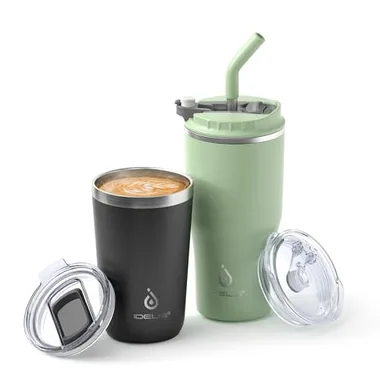
Measure your cup holder first, then match it against the pieces the maker describes as cup-holder friendly, listed below.
| Piece | Volume | Handle | Maker calls it cup-holder friendly |
|---|---|---|---|
| 14 oz tumbler with a straw | 14 oz | No | Yes |
| 14 oz tumbler with a handle and straw | 14 oz | Yes, desk piece | Not stated |
| 18 oz tumbler with a straw | 18 oz | No | Yes |
| 20 oz tumbler with a straw | 20 oz | No | Not stated |
| 32 oz tumbler with a handle and straw | 32 oz | Yes, desk piece | Yes |
| 17 oz travel tumbler | 17 oz | No | Yes |
| 20 oz travel tumbler, sliding lid | 20 oz | No | Not stated |
| 14 oz coffee mug with a handle | 14 oz | Yes, desk piece | Not stated |
| 16 oz coffee mug with a handle | 16 oz | Yes, desk piece | Not stated |
What a cup holder is actually built for
Car makers design holders around a small number of reference vessels, and for the last two decades that has meant a takeaway coffee cup and a soft-drink bottle. A medium paper cup is about 90 mm at the lip and tapers to roughly 60 mm at the base. A half-litre bottle is about 66 mm all the way down. Almost every holder on the road swallows those two.
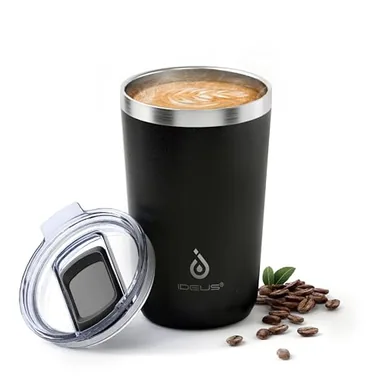
Insulated drinkware does not look like either. It is straight-sided or barely tapered, it is heavier when full, and it is usually taller. That mismatch, rather than any single measurement, is why so many tumblers ride high and rattle.
Rubber fingers and spring inserts complicate it further. They grip a small vessel nicely and refuse a large one outright, and they are the reason two people with the same car model can disagree about whether a tumbler fits: one has the insert, the other lost it years ago.
Depth, height and the thing above the holder
Diameter gets all the attention, and depth decides stability. A holder 40 mm deep grips the bottom of a 200 mm tumbler for a fifth of its height, which is enough to keep it in place and not enough to keep it from swaying. Anything shallower turns a full 32 oz into a pendulum.
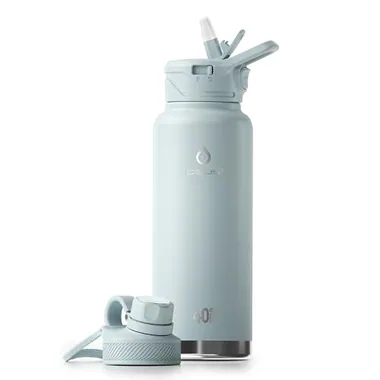
Height matters for a different reason: what sits above the holder. A console lid that closes, a gear selector that travels backwards, a climate control panel with buttons at elbow height. All of these are cleared by a paper cup and fouled by a 250 mm bottle, and none of them appear in any product specification anywhere.
The practical test takes ten seconds and cannot be done from a product page. Sit in the seat, put your usual travel vessel in the holder, and move the gear selector through its range with the console lid closed. Whatever fouls, fouls.
Weight, and the corner nobody thinks about
A full 32 oz weighs over a kilogram, and a holder that grips it loosely is holding a kilogram of moving liquid at every roundabout. Two consequences follow. The first is noise: an under-gripped vessel rattles, and the rattle is what makes people stop using an otherwise good tumbler. The second is the lid, and it is the reason this guide sits on a site about lids.
A vessel that tips in a car is a vessel that tests its lid, and a splash-proof lid tested that way loses. If your holder is generous and your drive is lively, take a piece whose product page claims leak-proof, even if it costs a little more, because the failure mode of the other choice is coffee in the footwell rather than a small inconvenience.
Measuring in metric and imperial without confusing yourself
American cup holders are usually discussed in inches, drinkware is usually specified in ounces, and rulers in a kitchen drawer are often metric. Two conversions do the whole job: an inch is 25.4 mm, and the common holder range of 2.6 to 3.4 inches is 66 to 86 mm.
| Holder size | Inches | Millimetres | What usually lives there |
|---|---|---|---|
| Small | 2.6 in | 66 mm | Older compact cars, rear consoles, some door pockets |
| Standard | 3.0 in | 76 mm | The size most holders are built to |
| Large | 3.4 in | 86 mm | Newer trucks and SUVs, often with an insert |
Measure the hole, not the cup you already own, and measure at the narrowest point rather than the lip: many holders flare at the top and grip lower down.
When the answer is a different piece entirely
There is a point at which fitting a bigger vessel into a smaller holder becomes an engineering project with no reward. Adapters exist, sleeves exist, and both add a failure point to a system whose whole job is not spilling.
The alternative is unglamorous and works: a smaller vessel for the car and a bigger one for wherever you are going. A 17 or 20 oz in the holder and a 32 oz in the bag covers a commute, a gym session and a day at a desk, and neither piece is asked to do a job it was not shaped for.
The printable ring, and why it beats a number
There is a set of rings on the cup-holder page drawn at three common holder sizes. Print the page at 100%, not “fit to page”, which silently rescales everything, and drop the rings over your holder. Whichever one your holder swallows is the size class you are shopping in.
If your printer scales anyway, the ruler method above gives the same answer in the same time. The point of the rings is not precision beyond a ruler. It is that a ring makes the answer obvious without any arithmetic.
When nothing fits
Some cars simply have small holders, and in those the honest answer is a smaller vessel rather than a better one. A 14 oz tumbler in a holder beats a 32 oz on the passenger seat, which is where the big one ends up, and which is the exact circumstance in which a splash-proof lid stops being adequate.
The other honest answer is to stop trying. A bottle in a door pocket or a bag, with a lid the maker calls leak-proof, solves the problem the console was never going to solve. That is a different purchase, and this range has one.